
How to Evaluate a Crypto Staking Validator: 7 Metrics That Matter Beyond APY

A high annual percentage yield (APY) does not automatically make a crypto staking validator a good choice. Validator reliability, commission fees, consensus participation, and network-specific penalties all affect staking outcomes.
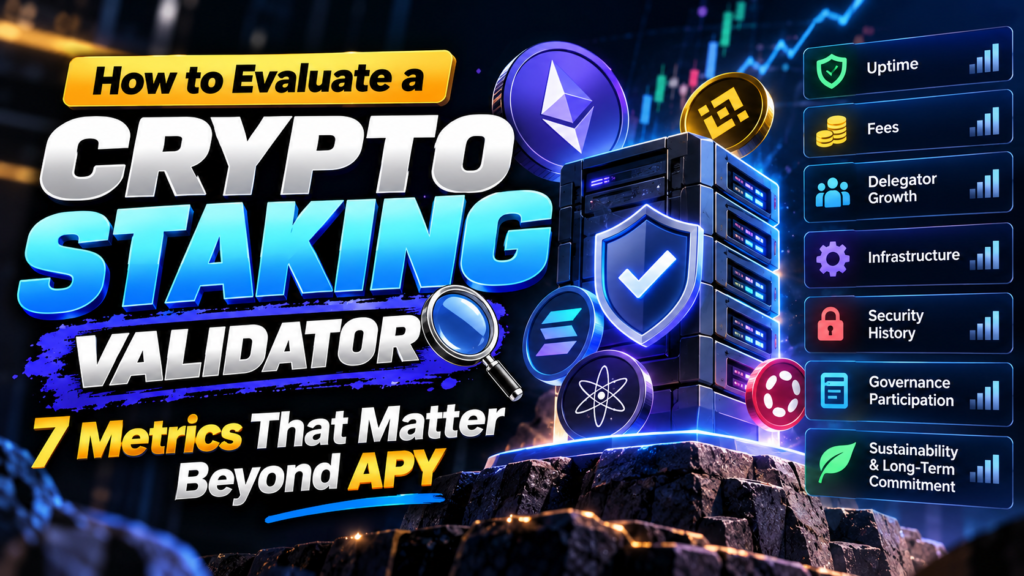
Evaluating these factors before delegating tokens helps investors compare validators using verifiable evidence rather than advertised returns alone.
What Does a Crypto Staking Validator Do?
A validator participates in a proof-of-stake blockchain’s consensus process. Depending on the network, its responsibilities may include proposing blocks, voting on transactions, and confirming the blockchain’s state. Stakers delegate assets to validators or operate their own validators to participate in network security and earn rewards.
Before assessing an operator’s performance, investors should understand how crypto staking works, including reward distribution, validator responsibilities, and the risks associated with different staking methods.
With this foundation, seven metrics can help investors evaluate a validator’s reliability and suitability.
1. Validator Uptime and Availability
Validator uptime measures how consistently a validator remains operational. Extended downtime can reduce rewards or result in performance penalties, depending on the blockchain’s rules.
Review historical availability over several weeks or months rather than relying on a single snapshot. Repeated outages, unexplained interruptions, and prolonged periods of inactivity deserve closer investigation.
What to check: Use the blockchain’s official explorer or validator dashboard to examine historical availability and performance records.
A validator with consistent operating history offers stronger evidence of reliability than one whose recent performance looks good but lacks a verifiable track record.
2. Network Participation and Consensus Performance
Being online does not guarantee that a validator performs its assigned duties effectively. Network participation metrics provide a clearer view of its contribution to consensus.
The relevant measurement depends on the blockchain. Solana uses vote credits to help determine staking rewards, while Cardano evaluates stake pool performance against expected block production. Ethereum validators are assessed through their consensus duties and associated rewards and penalties.
Consult the relevant network’s official staking documentation or equivalent resources before comparing metrics.
What to check: Examine missed duties, participation records, and performance relative to comparable validators over the same period.
Prefer operators with consistent participation and investigate unexplained performance gaps. Comparisons are meaningful only when the metrics and reporting periods are equivalent.
3. Validator Commission Fees
Validators charge commission in exchange for operating infrastructure and participating in network consensus. This fee generally represents a share of eligible staking rewards, not a direct charge on the original amount staked.
A lower commission can improve the portion of rewards retained by delegators, but it should not outweigh poor performance or inadequate transparency.
Check the current commission rate, its historical changes, and any additional fees charged by an exchange, wallet provider, or staking pool.
What to check: Verify the commission through official network tools and confirm how the fee is calculated.
Look for clearly disclosed rates and investigate frequent or poorly communicated changes. Compare total fees rather than commission alone, particularly when staking through third-party platforms.
4. Realized Rewards Versus Advertised APY
Advertised APY does not guarantee the return a staker will receive. Actual rewards depend on network conditions, validator performance, commission rates, and the assumptions used to calculate the quoted yield.
On some networks, total staked supply and protocol reward rules also influence staking returns. Compounding assumptions can create further differences between advertised APY and actual results.
Token-denominated rewards must also be separated from fiat returns. Earning additional tokens does not guarantee a profit if the token’s market price declines.
What to check: Compare historical rewards after applicable fees over equivalent periods. Confirm whether advertised yields assume compounding, include bonus incentives, or represent estimates rather than realized results.
A realistic assessment considers reward consistency and net token accumulation instead of selecting a validator solely because it advertises the highest APY.
5. Slashing History and Protocol-Specific Penalties
Slashing is a protocol-enforced penalty that can destroy part of a validator’s stake following specified misconduct on networks that implement the mechanism. The consequences for delegators depend on the blockchain’s rules and staking arrangement.
Ethereum, for example, penalizes certain conflicting validator attestations and block proposals. Solana’s staking documentation describes a different implementation: in-protocol slashing is not currently implemented as a routine penalty mechanism.
These differences make network-specific research essential. Do not assume that every blockchain applies the same penalties or that every validator failure results in slashing.
What to check: Review documented incidents, the reasons behind them, the operator’s response, and the protocol’s official penalty rules.
A transparent explanation of past incidents is more informative than an unsupported claim that a validator is risk-free.
6. Stake Concentration and Network Influence
A validator’s delegated stake can affect its influence within a proof-of-stake network. Where consensus weight depends on stake, concentration among a small number of operators can raise decentralization concerns.
Evaluate the validator’s share of network stake, its position relative to other operators, and whether substantial voting influence is concentrated among a limited group of entities.
However, a large stake does not automatically make a validator unsafe, and a small stake does not establish that an operator is reliable.
What to check: Review public stake distribution, validator rankings, and relevant decentralization statistics. Where possible, identify whether multiple validator identities belong to the same operator.
The objective is to understand both the individual validator’s performance and its influence on the wider network.
7. Operator Transparency and Security Practices
Public performance metrics cannot establish every aspect of an operator’s security. Investors should also assess the information available about the organization or individual running the validator.
Look for a verifiable operating history, clear communication about outages, documented security practices, and transparent disclosures concerning fees and maintenance.
Where information is available, examine infrastructure redundancy, client diversity, access controls, and key-management procedures. The importance of each measure depends on the blockchain and the operator’s setup.
What to check: Compare public claims with available documentation, operational records, and incident disclosures.
An anonymous operator is not automatically malicious, but limited verifiable information makes independent assessment more difficult. Treat unsupported guarantees and claims of risk-free returns as warning signs.
Validator Comparison Checklist
Use this table to organize the evidence before delegating assets.
| Metric | Evidence to review | Warning sign |
| Uptime | Historical availability | Repeated outages |
| Consensus performance | Network participation records | Persistent missed duties |
| Commission | Current rates and fee history | Poorly disclosed changes |
| Net rewards | Historical rewards after fees | Unsupported yield claims |
| Slashing and penalties | Incident records and protocol rules | Unexplained or undisclosed incidents |
| Stake concentration | Network stake distribution | Material concentration concerns |
| Transparency | Operator disclosures and security practices | Unverifiable claims |
Compare validators over equivalent periods and use network-specific data. No single metric provides a complete assessment of reliability.
What to Check Before Delegating Crypto
Before committing tokens, verify the validator through official network tools, review its historical performance, confirm the commission rate, and understand the network’s penalty rules.
Also examine custody arrangements, redelegation options, and withdrawal or unbonding periods. These conditions determine how much control you retain and when you can access your assets.
Remember that validator quality is only one component of staking risk. Token-price changes, protocol vulnerabilities, custody arrangements, and liquidity restrictions can affect the overall outcome.
Frequently Asked Questions
What Is the Most Important Metric When Choosing a Staking Validator?
No single metric establishes reliability. Historical performance, net rewards, commission fees, security practices, and network-specific penalties should be assessed together.
Does a Higher Validator APY Mean Better Returns?
No. Advertised APY does not guarantee realized returns. Network conditions, commissions, validator performance, compounding assumptions, and token-price movements affect the outcome.
Can You Lose Crypto by Delegating to a Validator?
Losses depend on the network and staking arrangement. Slashing where supported, other protocol penalties, custody risks, and market-price declines can affect the value of a staking position.
Conclusion
Choosing a crypto staking validator requires more than comparing advertised yields. Evaluate its operating history, consensus performance, fees, penalty exposure, stake concentration, and transparency before delegating. A decision based on verifiable evidence provides a stronger foundation for managing staking risk.