
How Real-Time Voice AI Is Bridging Global Language Divides

We are living in an era where digital connectivity is at an all-time high. Modern cloud platforms, global remote work hubs, and cross-border digital services allow businesses and creators to connect with audiences halfway across the globe in milliseconds. India, with its thriving tech ecosystem and massive multilingual population, stands at the very center of this global digital expansion.
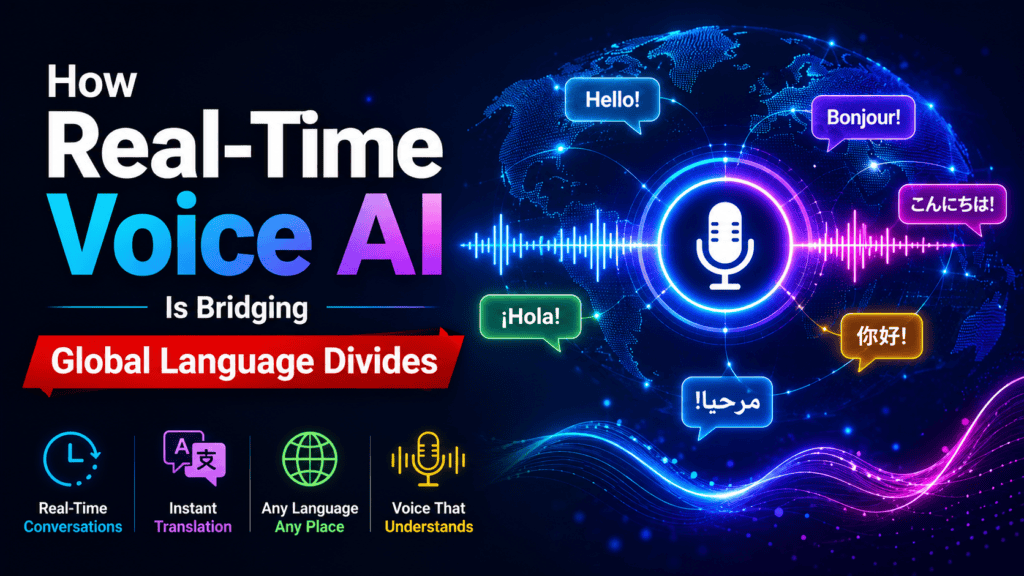
Yet, despite seamless internet infrastructure, a fundamental hurdle persists across global markets: the language barrier.
Whether it is a tech startup in Bengaluru pitching to international investors, a global enterprise managing distributed remote engineering teams, or a content creator broadcasting to a worldwide audience, language differences often create operational friction. Traditionally, bridging this gap meant relying on delayed text subtitles, localized post-production, or expensive manual translation. Today, deep learning innovations in real-time voice processing are changing the narrative entirely.
Overcoming the Bottleneck of Communication Latency
In any live digital interaction be it a corporate webinar, a virtual team sync, or a online training session latency is the enemy of engagement. Early voice translation tools relied on a slow, multi-step pipeline: waiting for a speaker to finish a sentence, converting speech to text, running a machine translation algorithm, and synthesizing translated audio. This sequential approach introduced 3-to-5-second delays per turn, disrupting natural conversation flow and causing fatigue.
Modern streaming neural architectures have overcome this limitation. By leveraging ai real time voice translation, incoming audio is processed concurrently with sub-second latency. Instead of waiting for full pauses, deep learning models analyze audio streams continuously and predict syntactic structures on the fly. This enables fluid, multi-lingual voice communication where participants can converse naturally in their native languages without awkward pauses or lost momentum.
Beyond Words: Context, Tone, and Nuance
While low latency is essential for smooth interactions, translation accuracy in professional environments demands far more than literal word replacement. A major flaw in basic translation engines is their inability to capture context, leading to awkward interpretations of technical jargon, colloquialisms, or cultural nuances.
True cross-lingual fluency requires advanced language interpretation services that evaluate dynamic sentence flow, intent, and emotional tone. Next-generation neural engines analyze conversational context to deliver accurate translations that feel natural to native listeners. By preserving the speaker’s vocal cadence and adapting regional idioms into their local equivalents, modern AI ensures that whether you are communicating technical specifications, sales pitches, or educational material, the underlying message remains intact.
High-Impact Applications Driving the Tech Era
The applications for context-aware, low-latency voice translation are rapidly multiplying across key sectors:
- Global Remote Collaboration: Distributed development and product teams can hold live strategy sessions where every team member speaks and listens in their preferred language, eliminating miscommunication in project execution.
- Virtual Conferences & Webinars: Event organizers can broadcast keynotes and panel discussions to a worldwide audience in dozens of languages simultaneously, expanding reach without massive translation teams.
- EdTech and Skill Development: Educational platforms and universities can deliver live lectures to international students in real time, making specialized tech education globally accessible.
- Cross-Border Customer Support: Companies can scale their sales and support capabilities internationally, enabling representatives to serve global customers natively without regional hiring bottlenecks.
The Future of Borderless Collaboration
As neural voice synthesis, low-latency streaming, and context-aware language models continue to mature, native language will no longer dictate business limits or market accessibility. The ultimate goal of voice technology is to eliminate technical friction allowing ideas, products, and innovation to move freely across geographical and linguistic borders.
By embedding real-time voice AI into everyday digital workflows, forward-thinking organizations, startups, and creators can unlock truly global, borderless growth in the modern digital era.