
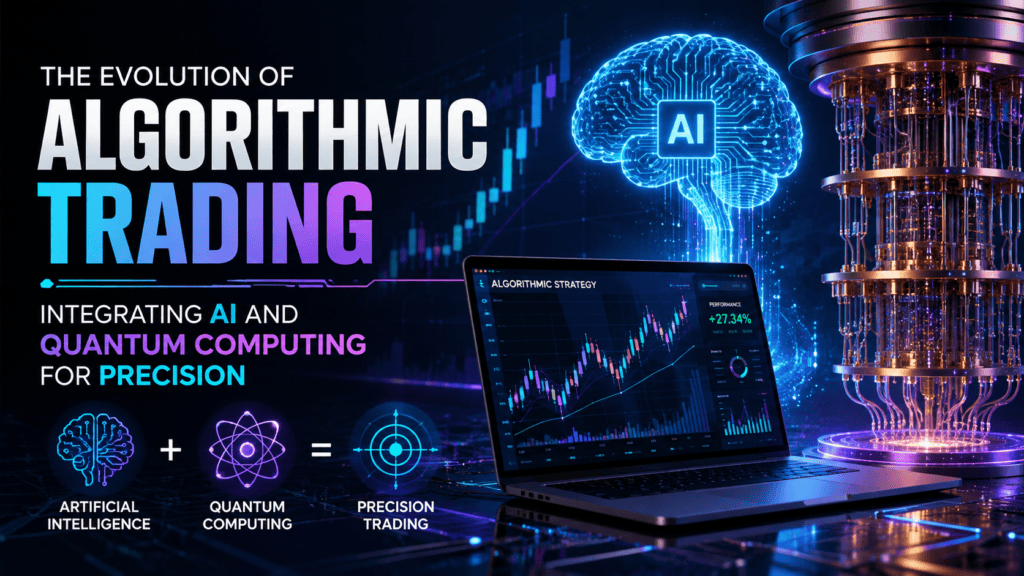
The Evolution of Algorithmic Trading: Integrating AI and Quantum Computing for Precision

Modern financial markets operate within a window of opportunity that is measured in microseconds. In a landscape defined by high-frequency data feeds and massive global volatility, the capacity to process information faster than an opponent has historically been the primary driver of edge.
However, the sheer volume of unstructured data generated by global crypto exchanges and stock markets has reached a point where traditional silicon-based processing faces a fundamental bottleneck. The latency arms race is no longer just about building shorter fiber optic cables; it is increasingly about the computational capacity to extract meaning from noise before that noise becomes obsolete.
The Limits of Classical Algorithmic Trading
Traditional algorithmic trading relies on deterministic, rule-based logic. These systems operate by monitoring specific price points, volume thresholds, or technical indicators and executing trades when pre-defined conditions are met. While highly effective for stable market regimes, these “if-then” architectures struggle during periods of extreme fragmentation or sudden liquidity shifts. The primary constraint is the linear nature of classical computing. A standard processor evaluates variables in a sequential or parallelized but fundamentally discrete manner.
As markets become more interconnected, the number of dependent variables—interest rates, geopolitical sentiment, correlated asset movements, and order book depth—increases exponentially. Classical systems must iterate through these possibilities one by one or via limited parallel threads. When market volatility spikes, the time required for a classical algorithm to recalculate its entire risk model can lead to slippage, where the executed price differs significantly from the intended price. The bottleneck is not just the speed of the hardware, but the mathematical difficulty of processing multi-dimensional datasets in real-time.
The Role of AI: From Rule-Based to Neural Networks
The first major shift occurred with the integration of machine learning into the trading stack. Rather than following rigid instructions, these algorithms utilize neural networks to identify non-linear patterns within historical and real-time datasets. This moved the industry from reactive programming to predictive modeling.
Machine learning models can ingest vast amounts of unstructured data—such as news feeds, social sentiment, and even satellite imagery for commodity forecasting—and recognize correlations that are invisible to human traders or simple scripts. These networks learn by adjusting internal weights based on past errors, allowing the system to adapt to changing market regimes without manual recalibration. While this significantly increased pattern recognition capabilities, these models still reside on classical hardware. They are subject to the same underlying computational limits when it comes to simulating millions of potential future market paths simultaneously.
Enter Quantum Computing: Solving the Optimization Problem
Quantum computing introduces a paradigm shift in how mathematical optimization is approached. Unlike classical bits that exist as either a zero or a one, quantum bits, or qubits, utilize superposition to represent multiple states simultaneously. When combined with entanglement, where the state of one qubit correlates with another regardless of distance, quantum systems can process complex probability distributions at a scale unattainable by traditional CPUs or GPUs.
In trading, the most difficult task is not just prediction, but optimization. Portfolio optimization requires finding the best possible distribution of assets to maximize return for a specific level of risk. This is a combinatorial problem that grows more difficult with every new asset added to the portfolio. For a classical computer, calculating the optimal weights for a thousand-asset portfolio involves an astronomical number of permutations. Quantum algorithms, such as the Quantum Approximate Optimization Algorithm (QAOA), are designed to navigate these massive solution spaces by effectively sampling the most promising paths through superposition, drastically reducing the time required to reach an optimal state.
The Convergence: Quantum AI Trading Systems
The future of high-precision execution lies in the hybrid architecture where classical and quantum systems perform complementary roles. In this model, the AI component maintains its strength in pattern recognition and feature extraction, while the quantum layer handles the heavy computational lifting of risk assessment and trajectory optimization.
This convergence is visible in the emergence of Quantum AI trading frameworks. These systems use classical neural networks to analyze market sentiment and price action, identifying a potential setup. Once a pattern is identified, the quantum-enhanced layer runs massive Monte Carlo simulations—simulating thousands of “what if” scenarios—to determine the optimal entry, exit, and position sizing with unprecedented precision. This hybrid approach addresses the two greatest challenges in automated trading: the need for deep intelligence and the need for massive-scale optimization.
To understand the leap in capability, consider a comparison across three critical dimensions:
- Standard Algorithmic Trading: High speed, low complexity. Relies on fixed rules; struggles with market shifts.
- AI-Enhanced Trading: Moderate speed, high complexity. Recognizes non-linear patterns but bound by classical processing limits during heavy volatility.
- Quantum AI Trading: Extreme speed, extreme complexity. Uses quantum mechanics to optimize massive datasets and multivariate risk models in real time.
Practical Implications and Future Efficiency
The practical deployment of these technologies focuses on reducing the “cost of error.” In high-stakes environments, even a minor miscalculation in risk exposure can lead to catastrophic losses. Quantum-enhanced optimization allows for more frequent and deeper stress testing. A trader can run a “black swan” simulation—testing how a portfolio reacts to a sudden 20% drop in liquidity or a massive interest rate hike—in a fraction of the time it would take a classical system.
Furthermore, improved precision leads to reduced slippage and tighter spreads. By accurately predicting the impact of an order on the market depth before it is even placed, these systems can execute large trades with minimal market impact. This efficiency is particularly vital in the cryptocurrency markets, where liquidity can be fragmented across dozens of global exchanges with varying degrees of stability.
The Path Ahead: Security and Scalability
As these computational capabilities scale, they bring new requirements for the underlying infrastructure. The move toward quantum-ready algorithms necessitates a parallel evolution in cybersecurity. The same quantum power that can optimize a portfolio could theoretically threaten current encryption standards. Consequently, the next generation of trading platforms must integrate quantum-resistant cryptography to ensure that automated execution remains secure against emerging threats.
The scaling of this technology from specialized research labs to accessible, globalized platforms is the next frontier. As quantum hardware becomes more stable and cloud-based quantum computing matures, the ability to leverage these advanced market tactics will likely shift from being a luxury for institutional hedge funds to a standard component of the global fintech ecosystem.